Benefits of Solar Submersible Pumps for Indian Agriculture and Homes
Switching to solar pumping solutions offers transformative advantages for Indian users. At Orbit Submersible Pumps & Motors, we see firsthand how these systems empower our customers.
Here is why making the switch is a smart investment:
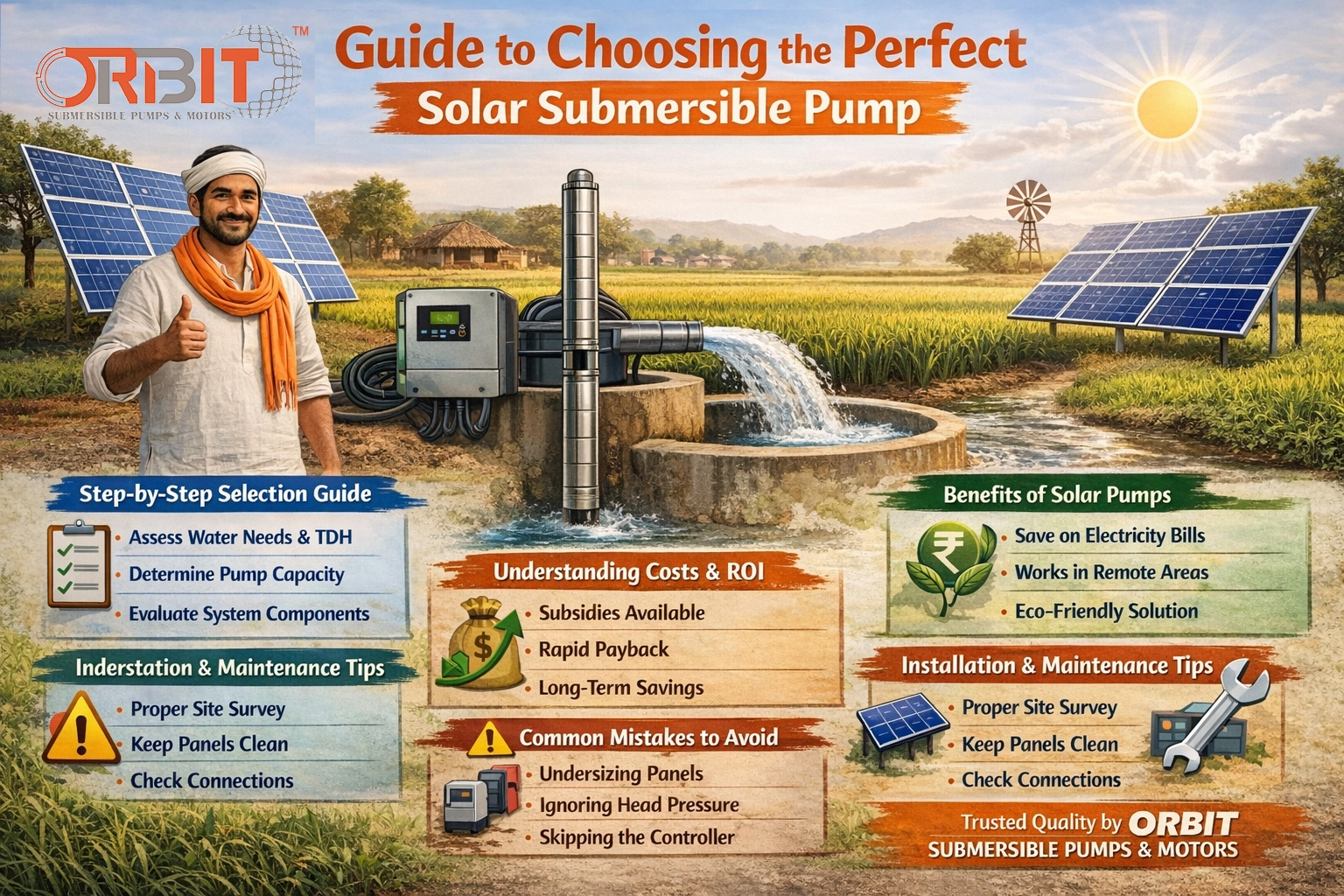
- Saves Electricity Costs: Solar pumps derive power from sunlight, a free energy source, eliminating electricity and fuel bills for substantial long-term financial benefits.
- Works in Remote Areas: These systems enable water pumping in regions where grid connections are unavailable, ensuring steady supply to rural homes and farms.
- Environmentally Friendly: They operate through renewable clean energy without carbon emissions, unlike diesel pumps.
- Easy Maintenance: With fewer operational components than conventional pumps, they are less vulnerable to breakdowns.
- Reliable Water Supply: When combined with storage tanks, they provide uninterrupted water supply even during low sunlight conditions.
Step-by-Step Guide to Choosing the Best Solar Submersible Pump
Choosing the right pump isn’t just about picking a model; it’s about matching the specifications to your unique environment. As your trusted partner in water management, Orbit Submersible Pumps & Motors recommends following a structured approach to ensure you get a system that performs efficiently for years to come. By evaluating your specific requirements first, you avoid the common trap of buying an oversized or undersized system.
Step 1: Assess Your Water Needs and Total Dynamic Head
The first step is understanding exactly how much water you use. Do you need water for domestic tasks like drinking and washing, or for extensive agricultural irrigation? Your daily requirement dictates the size of the pump needed.
Next, calculate the Total Dynamic Head (TDH). This includes the vertical distance from the water source to the discharge point, plus friction losses in the pipe. Submersible pumps are essential when the water source is located at a great depth below the surface . Accurate measurements here prevent low pressure issues later.
Step 2: Determine Pump Capacity, Type, and Efficiency
Once you know your head and flow requirements, you must select the right pump type. Solar pumps generally come in DC and AC variations. DC pumps are often more efficient for smaller, low-head applications, while AC pumps are better suited for higher power requirements and deeper wells.
At Orbit Submersible Pumps & Motors, we focus on high-efficiency models that maximize water output per watt of solar energy. Ensure the pump’s flow rate (measured in liters per minute or hour) matches your peak demand times. An efficient pump means you can often use fewer solar panels, saving on upfront costs.
Step 3: Evaluate System Components and Compatibility
A pump is only as good as the components powering it. You need to ensure the solar panels, controller, and pump are perfectly matched.
Key compatibility factors include:
- For DC pumps: A direct connection to solar panels with a DC buck converter is used to regulate voltage.
- For AC pumps: An inverter is required to convert DC electricity from panels into AC power.
- Controller Logic: Direct connection of solar panels to pumps without a controller is not advisable; a comprehensive system ensures stable power delivery.
Understanding Costs, Subsidies, and ROI in India
We know that cost is a major factor for our customers. It is true that solar water pumps have high initial financial requirements compared to standard electric pumps. However, at Orbit Submersible Pumps & Motors, we encourage you to look at the bigger picture!
The Return on Investment (ROI) is compelling because the operational expenses are virtually eliminated. Once installed, the energy source—sunlight—is free. Additionally, various government schemes in India, such as PM-KUSUM, often provide subsidies to help offset setup costs for farmers. While the upfront investment is higher, the system pays for itself over time through savings on diesel and electricity bills.
Best Practices for Installation and Maintenance
To get the most out of your Orbit Submersible Pumps & Motors product, proper installation and care are non-negotiable. Even the best pump will fail if installed incorrectly or neglected. We believe in empowering our customers with the knowledge to keep their systems running smoothly for decades.
Conducting a Proper Site Survey
Before installation, a thorough site assessment is critical. You must ensure the location for the solar panels has maximum exposure to sunlight throughout the day.
- Shadow Analysis: Ensure no trees or buildings cast shadows on the panels, as this drastically reduces output.
- Space Requirements: Solar panels require sufficient open space for sunlight exposure to function efficiently.
- Proximity: Keep the panels as close to the pump as possible to minimize voltage drop in the cables.
Ensuring Long-Term Durability and Efficiency
Maintenance for solar pumps is generally low, but “low maintenance” doesn’t mean “no maintenance.”
- Panel Cleaning: Keep solar panels free of dust, bird droppings, and debris to maintain peak power generation.
- Connection Checks: Periodically inspect wire connections for corrosion or looseness.
- Storage Management: If you use a storage tank, ensure it is clean to prevent sediment from clogging the system.
These systems maintain operation for numerous years until large-scale maintenance becomes necessary when properly cared for.
Common Mistakes to Avoid
In our experience at Orbit Submersible Pumps & Motors, we see many users make avoidable errors that compromise their system’s performance. Being aware of these pitfalls can save you money and frustration.
Avoid these common errors:
- Undersizing Solar Panels: The solar panel dimensions should be proportional to the required electrical power of the pump. If you skimp on panels, your pump won’t run during early mornings or late afternoons.
- Ignoring Head Pressure: Buying a pump based only on flow rate without considering the vertical lift (head) will result in little to no water reaching the surface.
- Skipping the Controller: Connecting panels directly to the motor can cause voltage spikes that damage the internal windings.
- Neglecting Backup Needs: Remember that the pump fails to function during nighttime unless backup batteries are installed.
Conclusion
Investing in a solar submersible pump is a smart step toward energy independence and sustainable water management. As India’s leading manufacturer, Orbit Submersible Pumps & Motors is committed to providing you with high-quality, durable solutions that stand the test of time.
By assessing your water needs, choosing the right components, and following best practices for installation, you can ensure a reliable water supply for your home or farm. The long-term advantages—from zero fuel costs to eco-friendly operation—far outweigh the initial setup efforts. We are here to support you every step of the way!
Frequently Asked Questions
What is the average lifespan of an Orbit Submersible Pumps & Motors solar submersible pump?
Our durable solar submersible pumps last 15-25 years with proper care. We use high-grade stainless steel and corrosion-resistant materials for reliable performance in harsh Indian conditions.
What size solar panels are needed for a 1 HP solar pump from Orbit Submersible Pumps & Motors?
A 1 HP pump requires 1000-1200 watts of solar panels for optimal efficiency. Our systems ensure maximum output even during monsoon seasons in Ahmedabad.
Can Orbit Submersible Pumps & Motors solar pumps work with batteries for nighttime use?
Yes, our pumps integrate with lithium-ion batteries for 24/7 operation. This provides reliable water supply during cloudy days or nights, perfect for continuous irrigation!
What warranty does Orbit Submersible Pumps & Motors offer on solar submersible pumps?
We provide a 2-year comprehensive warranty on pumps and 5 years on solar panels. Our trusted service network in Gujarat ensures quick resolutions for peace of mind!
Check out our related articles