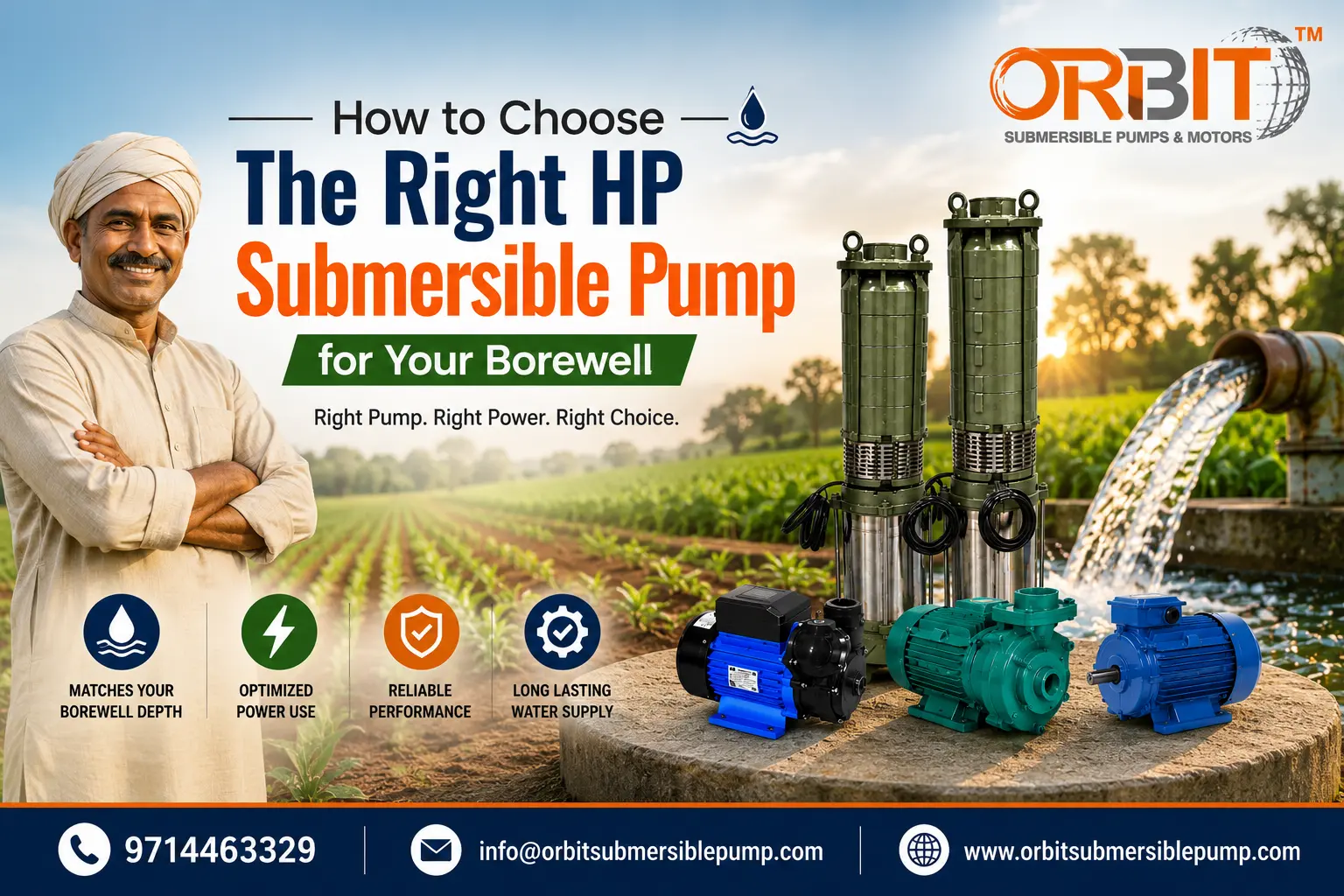
Choosing the right HP (horsepower) for your submersible pump is one of the most important decisions you will make for your borewell. Pick a pump that is too weak, and it will struggle to lift water from deep down. Pick one that is too powerful, and you will waste money on the pump itself and on electricity every month. Many farmers and homeowners end up with the wrong HP pump simply because they were not sure what to check before buying. In this blog, we will explain in simple words how to choose the right HP submersible pump for your borewell, so you get strong, reliable water flow without overspending.
What Does HP Mean for a Submersible Pump?
HP, or horsepower, tells you how much power the pump’s motor can deliver. A higher HP motor can lift water from greater depths and push out more water per hour, but it also draws more electricity. The right HP for your borewell depends on how deep your water level is, how much water you need, and the size of your pipeline, not just on picking the biggest number available.
Why Choosing the Correct HP Matters
Getting the HP wrong causes real problems down the line:
- An undersized pump cannot lift water efficiently from deeper borewells, leading to weak flow or the motor running constantly under strain.
- An oversized pump draws more current than needed, increasing your electricity bill without any real benefit.
- A mismatched pump can also wear out faster, since it is either overworked or running inefficiently for its size.
- The right HP pump gives steady, dependable water flow while keeping running costs as low as possible.
Key Factors to Check Before Choosing HP
Depth of the Borewell and Water Level
The deeper your water level, the more power (head) is needed to lift it to the surface. A shallow borewell with water close to the surface needs less HP than a deep borewell where the water level has dropped far down.
Total Water Requirement
Think about how much water you need per hour or per day, whether for irrigating a certain number of acres, filling an overhead tank, or supplying a home or small industry. Higher water demand generally calls for higher HP, combined with the right flow rate.
Borewell Diameter
The pump you choose must physically fit inside your borewell casing. Always check the borewell diameter, since it can also limit which HP and pump size options are practical for your setup.
Pipeline Length and Diameter
A long or narrow pipeline creates more resistance, which means the pump has to work harder to push water through it. If your delivery pipeline is long, you may need slightly higher HP than for a short, wide pipeline.
Power Supply Type
Check whether you have single-phase or three-phase electricity connection, and whether you plan to run the pump on grid power, a generator, or a solar power setup, since this affects which HP and motor options are available to you.
A Simple Way to Estimate the Right HP
While an exact calculation depends on total head (vertical lift plus pipeline friction) and required flow rate, here is a simple general guide farmers and homeowners can use as a starting point:
- Shallow borewells with moderate water needs often work well with smaller motors, generally in the 0.5 HP to 3 HP range.
- Medium-depth borewells with larger irrigation needs typically require mid-range motors, often between 3 HP and 10 HP.
- Deep borewells or large-scale irrigation and commercial needs may require higher HP motors, going up to 15 HP or 20 HP.
These ranges are only a general starting point. The safest approach is to share your borewell depth, water table, pipeline details, and daily water requirement with a trusted pump manufacturer, who can recommend the exact HP and model suited to your situation.
Other Tips for Choosing the Right Pump
- Always check the pump’s flow rate (in litres per hour or cubic metres per hour) along with HP, since the two work together.
- Choose a pump built with quality materials and proper certifications, such as ISO, BEE, and ISI, to ensure it performs as rated and lasts longer.
- If you are in a sunny region, consider a solar DC submersible pump, which is available in a range of HP options and can significantly cut your running costs.
- Avoid guessing the HP on your own if you are unsure; a quick consultation with the manufacturer can save you from an expensive mistake.
Orbit Submersible Pumps & Motors, manufactured by Vishvakarma Engineering Works in Odhav, Ahmedabad, offers submersible pumps and solar DC submersible pumps across a wide HP range, from 0.5 HP to 20 HP, to suit borewells of different depths and water requirements. Their team can help you match the correct HP, flow rate, and head to your specific borewell before you buy.
Conclusion
Choosing the right HP submersible pump is not about picking the strongest motor available, it is about matching the pump’s power to your borewell’s depth, your water needs, and your pipeline setup. Getting this right means steady water flow, lower electricity bills, and a pump that lasts for years without unnecessary strain. Before buying your next submersible pump, take the time to measure your borewell depth, estimate your water requirement, and consult a trusted manufacturer to select the HP that truly fits your needs.
Frequently Asked Questions (FAQs)
How do I know what HP pump I need for my borewell?
You need to consider your borewell’s depth, the water level, your daily water requirement, and your pipeline length. A pump manufacturer can help calculate the exact HP once you share these details.
Does a deeper borewell always need a higher HP pump?
Generally yes, since lifting water from greater depths requires more power. However, the exact HP also depends on your required flow rate and pipeline setup, not depth alone.
What happens if I install a pump with too much HP for my borewell?
An oversized pump draws more electricity than necessary and can put unwanted strain on the borewell, without giving you any real benefit in water supply.
Can I use a low HP pump to save on electricity bills?
Only if the HP still matches your borewell’s depth and water requirement. Using an underpowered pump to save costs often results in weak water flow and a motor that struggles constantly.
Are solar submersible pumps available in different HP options?
Yes, solar DC submersible pumps are available across a range of HP options, allowing you to choose one suited to your borewell depth and water needs while cutting your electricity costs.
Where can I get help choosing the right HP pump for my borewell?
Orbit Submersible Pumps & Motors, based in Odhav, Ahmedabad, offers submersible and solar DC pumps from 0.5 HP to 20 HP and can guide you in selecting the right HP based on your borewell details. You can contact them through their website for advice and quotes.